

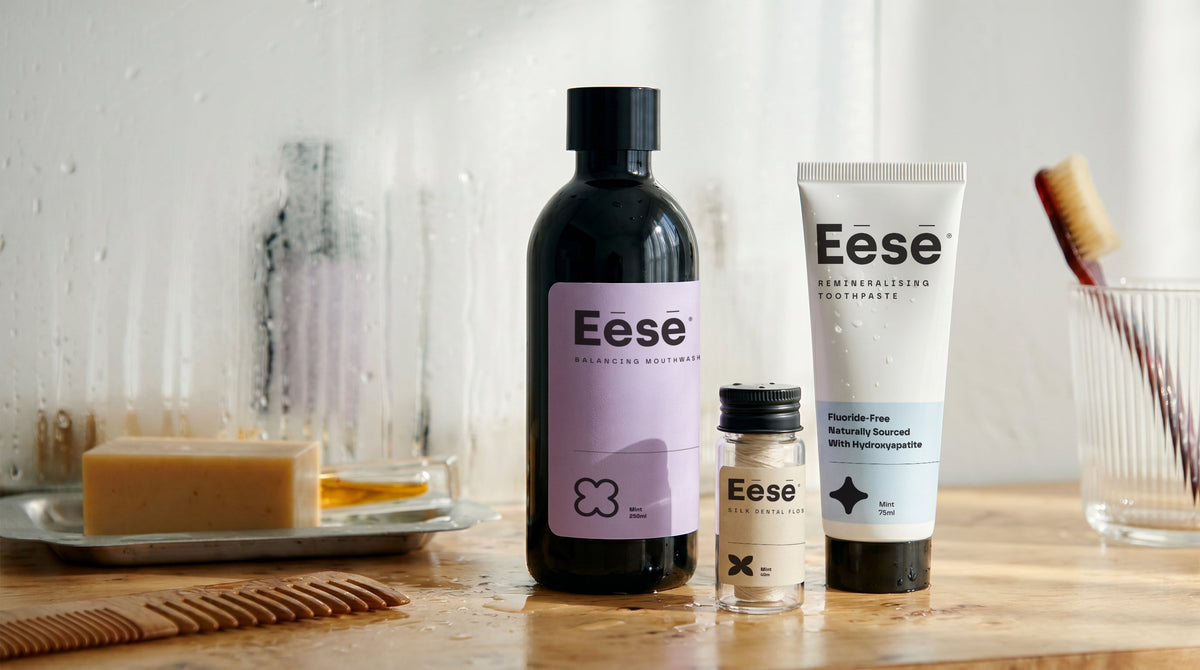
Oral care is evolving. A handful of ingredients, once considered "alternative," now have enough clinical trial data behind them to stand on their own merits. Here's what the research says about each one.
Hydroxyapatite: the mineral your teeth are already made of
Your enamel (the hard outer surface of your teeth) is roughly 97% hydroxyapatite, a naturally occurring form of calcium phosphate [1]. It's not a synthetic add-in trying to mimic your biology. It is your biology.
How it works:
-
When enamel loses minerals to everyday acid exposure (from food, drinks, or bacterial activity), hydroxyapatite particles bind directly to those weakened areas.
-
This helps rebuild the enamel surface through the same natural remineralisation process your saliva does on a smaller scale every day [2].
[IMAGE: microscopic-style illustration of hydroxyapatite particles filling in a demineralised area of enamel]
What the clinical trials show:
-
An 18-month, double-blinded, randomised clinical trial in adults found that fluoride-free hydroxyapatite toothpaste was non-inferior (meaning statistically equivalent) to a standard 1,450 ppm fluoride toothpaste for preventing new decay [3].
-
A separate trial found the same result for remineralising early caries lesions [4].
-
Multiple studies have found no safety concerns associated with hydroxyapatite use, even at higher concentrations [3,4,5].
-
Because it’s a mineral your body already has plenty of, there's no ingestion caution required the way there is with fluoride.
-
It's also been shown to help ease sensitivity, by physically sealing the microscopic tubules in exposed dentin that transmit hot, cold, and pressure signals to your nerves, rather than numbing them chemically [5].
Xylitol: natural sweetness that bacteria CAN’T feed on
Xylitol is a naturally occurring sugar alcohol, and its magic trick is that cavity-causing bacteria, particularly Streptococcus mutans, can't metabolise it properly. They try to consume it the way they would sugar, but they can't extract usable energy from it, which stops them from thriving and producing the acid that erodes enamel [6].
-
Studies have found a linear, dose-dependent reduction in S. mutans levels as xylitol frequency and amount increases [7].
-
Meaningful reductions typically require 5 to 10 grams per day, divided across three or more exposures [7,8]. You can find it across the [whole Eēsē routine].
-
Xylitol has been extensively studied and is considered fully safe at recommended intakes, with side effects (mild digestive upset) only appearing at intakes around 4 to 8 times higher than the effective dose [9].
This is why we think about xylitol as part of a full daily routine, toothpaste, mouthwash, and any xylitol-based products, rather than relying on a single, small dose.
[IMAGE: illustration of xylitol molecules interacting with bacteria, or simple lifestyle shot of the Eēsē toothpaste with xylitol highlighted on label]
Paraprobiotics: working with your microbiome, not against it
We've written more on this in our piece on the oral microbiome. The short version:
-
Paraprobiotics are probiotic cells that have been inactivated to make them stable, so they can be used in a toothpaste or mouthwash formula without refrigeration.
-
They carry beneficial compounds that interact positively with your oral environment, competing with harmful bacteria and helping regulate your body's inflammatory response [10,11].
-
In a six-month clinical trial, a paraprobiotic-based toothpaste and mouthwash routine produced greater reductions in bleeding, plaque, and pathogenic "red complex" bacteria than a conventional chlorhexidine-based routine, all while avoiding the microbiome disruption chlorhexidine is known to cause [11,12].
That's a genuinely significant finding: a gentler approach outperforming the harsher, more established one.
Essential oils and herbs: nature's antimicrobials that stand the test of time
Plant-derived compounds like thyme, clove, and natural mint deliver more than just a pleasant, fresh taste. Here’s what the studies show:
-
Clove's primary compound, eugenol, has documented antibacterial and anti-inflammatory properties that have made it a mainstay in dentistry for over a century [15].
-
Chamomile and green tea extracts have also demonstrated measurable antimicrobial activity against oral bacteria in head-to-head comparisons [16].
The advantage of botanicals over synthetic antiseptics isn't just "natural sounds nicer." It's that they tend to support the mouth's own defences (like saliva flow and a stable pH) rather than indiscriminately wiping out everything in their path [17].
Beeswax-coated floss: the small swap with an outsized impact
-
Most conventional floss is coated with PTFE to help it glide smoothly between teeth. PTFE belongs to the PFAS family, so-called "forever chemicals" (like Teflon) that don't break down in the environment.
-
Recent research has found a measurable association between regular floss use and higher serum PFAS levels [18].
-
Consumer Reports and independent lab testing bodies now specifically recommend seeking out floss coated in natural waxes instead [18,19].
Beeswax does the same practical job, letting the floss glide easily between tight contacts, without the PFAS exposure or the plastic waste. It's a genuinely simple substitution that performs just as well.
Sodium lauryl sarcosinate: foam that’s kind to the gums.
If you want the satisfying lather of brushing without the mucosal irritation linked to SLS, sodium lauryl sarcosinate (sometimes labelled SLSa) is the ingredient doing that work:
-
It's derived from lauric acid (found in coconut oil) and sarcosine, a naturally occurring amino acid derivative.
-
It delivers comparable foam and cleaning performance to SLS with a meaningfully gentler profile on oral tissue [20,21].
-
It's increasingly the surfactant of choice in sensitive and children's toothpaste formulations across Europe [20,21].

Why these ingredients work best together
Every one of these ingredients earns its place through evidence, not trends. But they also address different parts of the same ecosystem:
-
Hydroxyapatite and xylitol do their best work on the tooth surface itself.
-
Paraprobiotics and botanicals support the wider ecosystem: gums, tongue, and saliva included.
-
Pure silk floss coated with hydroxyapatite, xylitol and beeswax delivers natural protection to the 40% of your mouth that a brush physically can't reach.
References
-
Limeback H, Meyer F, Enax J. Tooth Whitening with Hydroxyapatite: A Systematic Review. Dent J (Basel). 2023;11(2):50.
-
Hannig M, Hannig C. Nanomaterials in preventive dentistry. Nat Nanotechnol. 2010.
-
Schlagenhauf U, et al. Caries-preventing effect of a hydroxyapatite-toothpaste in adults: an 18-month double-blinded randomized clinical trial. Front Public Health. 2023.
-
Amaechi BT, et al. Comparative efficacy of a hydroxyapatite and a fluoride toothpaste for prevention and remineralization of dental caries in children. BDJ Open. 2019.
-
Kensche A, et al. Efficacy of a mouthrinse based on hydroxyapatite to reduce initial bacterial colonisation in situ. Arch Oral Biol. 2017 (safety and sensitivity findings cross-referenced across HAP clinical literature).
-
Bahador A, et al. Effect of xylitol on cariogenic and beneficial oral streptococci: a randomized in-vivo study. Iran J Microbiol, and related mechanistic reviews.
-
Ly KA, et al. Linear response of mutans streptococci to increasing frequency of xylitol chewing gum use: a randomized controlled trial. BMC Oral Health. 2006.
-
American Academy of Pediatric Dentistry. Policy on Use of Xylitol in Pediatric Dentistry. 2022.
-
Bahador A, ALHumaid J, Bamashmous M. Is xylitol effective in the prevention of dental caries? A systematic review. Med Oral Patol Oral Cir Bucal. 2024.
-
Sadeghi-Nejad, et al. A comprehensive review of the application of probiotics and postbiotics in oral health. Front Cell Infect Microbiol. 2023.
-
Butera A, et al. Paraprobiotics in Non-Surgical Periodontal Therapy: Clinical and Microbiological Aspects in a 6-Month Follow-Up Domiciliary Protocol for Oral Hygiene. Microorganisms 2022;10(2):337.
-
Bescos R, et al. Effects of Chlorhexidine Mouthwash on the Oral Microbiome. Scientific Reports. 2020;10:5254.
-
Fani M, et al. Effect of a tea tree oil mouthwash on plaque-induced gingivitis when comparing to chlorhexidine: an exploratory randomised clinical trial. Front Oral Health. 2026.
-
Priya BM, et al. Clinical and Microbiological Evaluation of 0.2% Tea Tree Oil Mouthwash in Prevention of Dental Biofilm-Induced Gingivitis. Dent J (Basel). 2025;13(4):149.
-
Dobler D, et al. Effect of essential oils on oral halitosis treatment: a review. Eur J Oral Sci. 2020.
-
Naghsh N, et al. A comparative evaluation of the antimicrobial effect of chamomile, aloe vera, green tea, and chlorhexidine mouthwashes on some oral bacterial species. Dent Res J (Isfahan). 2023;20:70.
-
Ledder RG, McBain AJ. Modelling probiotic and herbal interventions to control oral malodour. Sci Rep, and related oral microbiome preservation studies.
-
Jiao Y, et al. Association Between Serum Levels of Perfluoroalkyl and Polyfluoroalkyl Substances and Dental Floss Use. J Clin Periodontol. 2025.
-
Consumer Reports. How to Choose Dental Floss Without PFAS and Other Harmful Chemicals. 2025.
-
Cinoll. Ingredients to Replace Sodium Lauroyl Sarcosinate/formulation comparisons of SLS vs SLSa. 2026.
-
Pharcos. Sodium Lauroyl Sarcosinate: formulation applications in sensitive and paediatric toothpaste. 2026.
This article is intended for general educational purposes and is not medical advice. As with any new oral care product, if you have specific dental concerns, please consult your dentist.

